Cosmic Specks
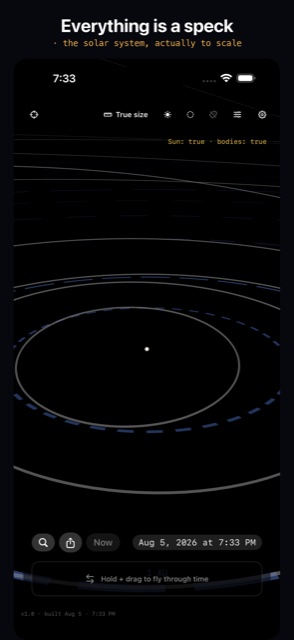
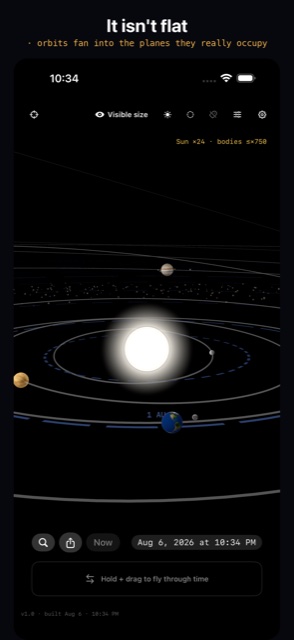
Cosmic Specks is the solar system built at true scale — the empty space included. Every orbit is exactly to scale, from Mercury hugging the Sun out to Neptune in the dark. Place it in your room in AR, or explore the whole system right on screen.
For iPhone & iPad, iOS 17 and later. Free, with one optional purchase.
Honest about what it shows you
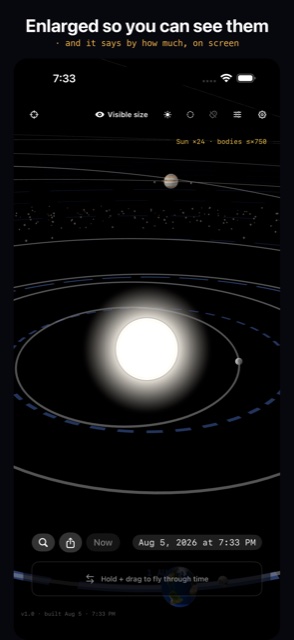
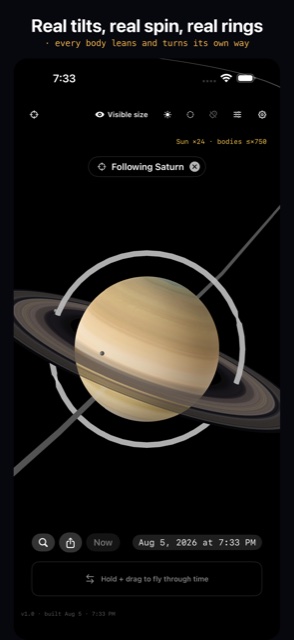
At true scale the planets are specks — that is the point, and most astronomy apps quietly hide it by shrinking the distances or inflating the worlds. This one enlarges the bodies so you can see them, then says so on screen, live: Sun ×24 · bodies ≤×750. One tap switches to true size, and the specks come back.
Real orbital mechanics, not an animation
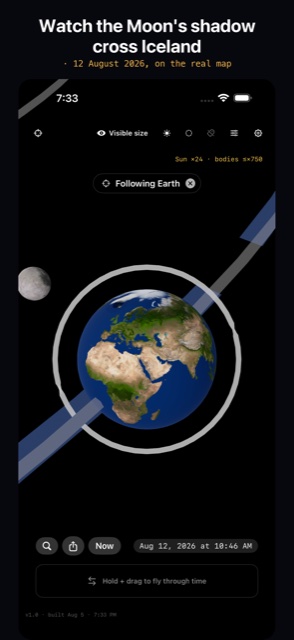
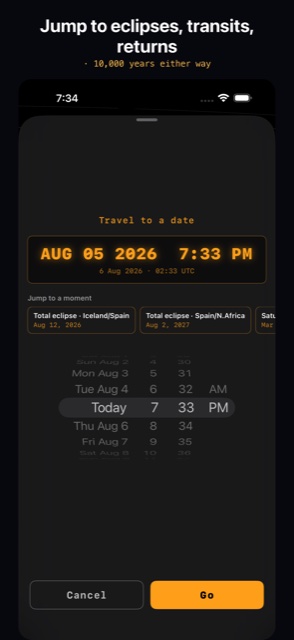
Scrub time and the planets go where they actually were. The Moon is modeled closely enough that eclipse shadows land on the correct geography — on 12 August 2026 you can follow Earth’s daylit side and watch the umbra cross Iceland and northern Spain, mainland Europe’s first totality since 1999. Keep scrubbing and you reach 2027 over North Africa, Apollo 11, or Eddington’s 1919 eclipse.
Positions come from a fixed J2000 model, so the app flags its own accuracy as you travel: good near today, approximate centuries out, illustrative in the deep millennia.
Support
Questions, bugs, or something that looks wrong in the sky? I’d genuinely like to hear it — corrections especially.
Email: kaolin@gmail.com
I read everything and usually reply within a few days.
Privacy
Cosmic Specks collects nothing. No account, no sign-in, no tracking, no analytics, no ads, no third-party SDKs. There is no server: everything runs on your device, and no personal data ever leaves your phone.
The camera is used only to draw the solar system into the room in front of you. Frames are never recorded, stored, or transmitted — and you can skip the camera entirely and explore on screen instead. Your location is never requested.
The app offers one optional in-app purchase. Payment is handled entirely by Apple through the App Store; I never see your payment details.
Because nothing is collected, there is nothing to share, sell, or delete.